
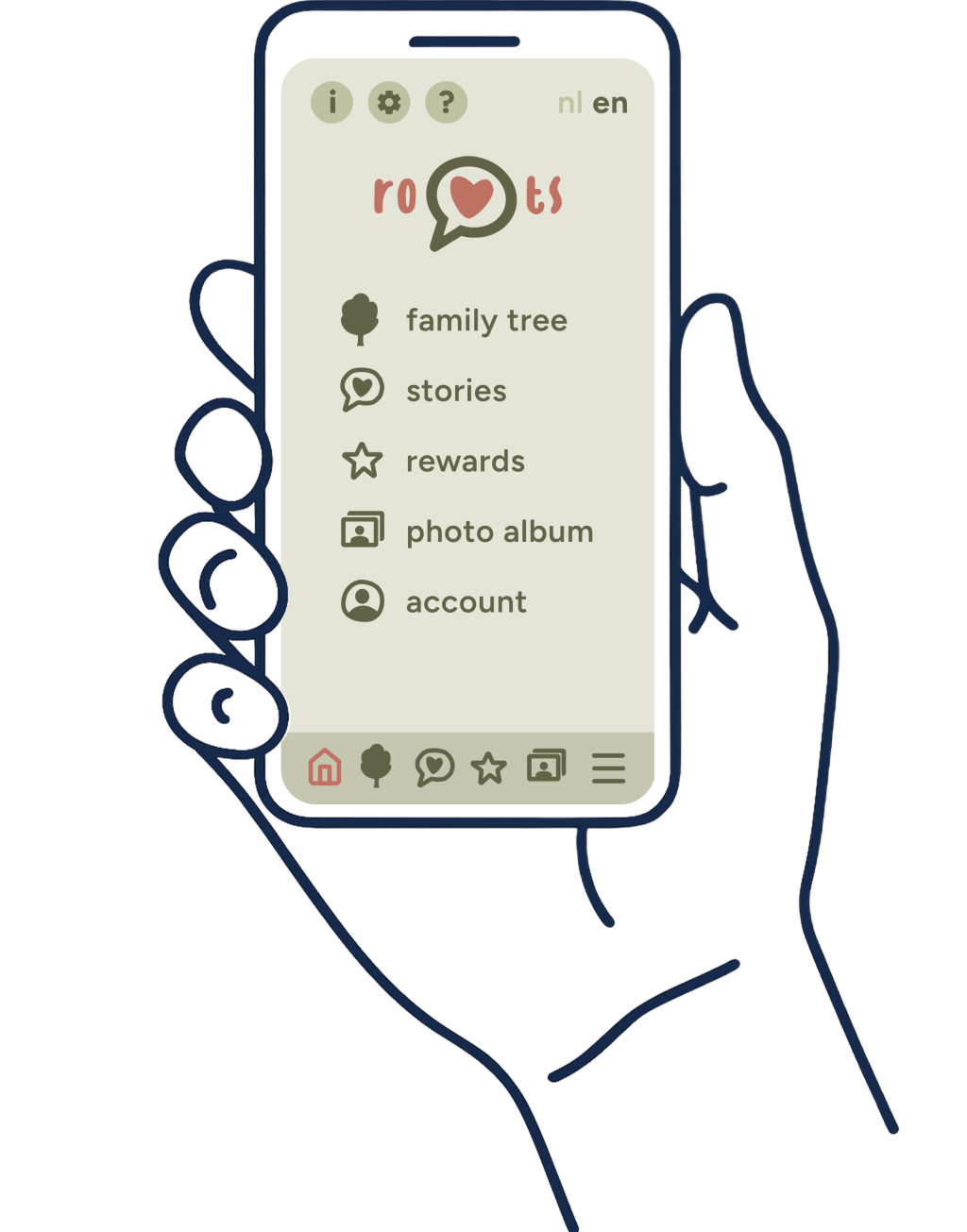
A mobile application for creating your family tree through building stories.
Project
UX Research
UI Design
Team
Silke Franken ✿ Teddy van Amelsvoort ✿ Kelly Chen ✿ Hrvoje Miljak ✿ Esmée Torn
Silke Franken (solo)
Tools
Design thinking process ✿ qualitative user research
Procreate ✿ Figma
The brief
In 2021, over 55 million people worldwide were living with dementia (PWD), with about 10 million new cases each year due to population aging [1]. Despite this, awareness remains low, leading to stigma and barriers in diagnosis and care [1]. As symptoms progress, PWD become more dependent on others, threatening their autonomy and quality of life [2, 3], and increasing their risk of loneliness [4].
This project focused on designing a warm technology for people with dementia – a tool centered on their needs rather than practical problems. It explored how to enhance their quality of life by reducing loneliness and fostering social connectedness to support cognitive health [5].
The design process
To come up with a suitable User Experience Design to facilitate the interaction of people with dementia with others, the design thinking process was used [6]. Below, all the steps are described in more detail. For more details about the project and results, feel free to contact me.

Emphathise
After the conduction of a literature review about the experience of PWD, field observations and conversations at a community hall provided insights into daily life, needs, and social interactions. Semi-structured interviews with a caregiver and family member highlighted challenges, well-being, and the importance of social connectedness and communication.

Define
Thematic analysis identified six key themes: social connectedness, reminiscence of the past, altered social behaviour, dementia’s cognitive impact, communication challenges, and mixed emotional responses. These insights informed the goal to design a social mediation tool that strengthens interactions between people with dementia and younger individuals.

Ideate
Through the brainwriting ideation technique, the chosen concept was a family tree educational game mobile application, which supports reminiscence, eases communication, and fosters intergenerational bonding.

Prototype
In the prototyping phase, the Roots app was developed as a family tree tool to connect young people with relatives with dementia through memory sharing, conversation prompts, and gamified engagement. Key requirements included secure local storage and a simple, intuitive interface for accessibility.
Low fidelity prototype: A static prototype with was created to test usability, clarity, and appeal among younger users.

Test
In this phase, Roots was evaluated through testing with PWD and teenagers. PWD responses varied: later-stage participants were reluctant to discuss about family, while earlier-stage users shared memories more openly. Teenagers found the concept appealing and suggested features like communication tools, adaptive prompts, expert advice, and stronger privacy.
Solution and results
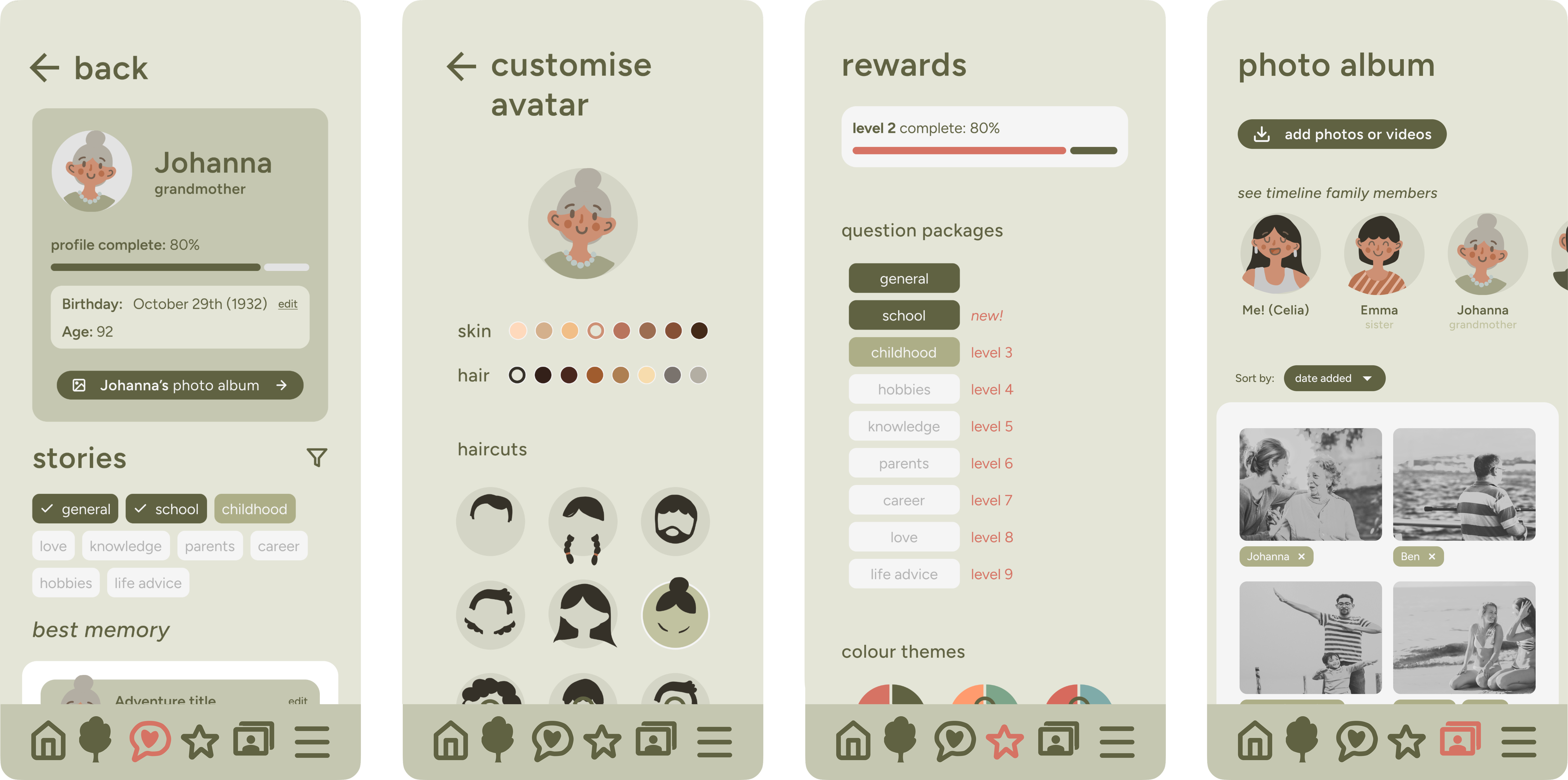

The final result is a high-fidelity Figma prototype developed after the official UX research project. It includes most screens of the Roots mobile family tree app, offering a realistic view of its experience and interactivity. This version targets elderly users in general, though additional features—such as dementia information or tips for interacting with PWD—could be added for a more specific focus on PWD.
The interactive Figma prototype can be accessed here.


Reflection
User testing with the low-fidelity prototype involving teenagers and PWD provided valuable feedback. Teenagers suggested adding expert advice on interacting with people with dementia, general information, and raised privacy concerns. This feedback will be further explored in future work.
Future testing should use the high-fidelity prototype to assess not only features but also interactivity, involving real grandparent–grandchild pairs across a wider age range.
Finally, future iterations will consider more accessibility options, such as high-contrast modes and text enlargement, to improve usability for people with visual impairments.
References
[1] World Health Organization (2021, September 2). Dementia Fact Sheet. Retrieved October 7th, 2025, from https://www.who.int/news-room/fact-sheets/detail/dementia.
[2] Bjørkløf, G.H., Helvik, AS., Ibsen, T.L. et al. (2019). Balancing the struggle to live with dementia: a systematic meta-synthesis of coping. BMC Geriatr 19, 295. https://doi.org/10.1186/s12877-019-1306-9
[3] Smebye, K. L., Kirkevold, M., & Engedal, K. (2015). Ethical dilemmas concerning autonomy when persons with dementia wish to live at home: a qualitative, hermeneutic study. BMC health services research, 16(1), 1-12.
[4] O’Rourke, H.M., Collins, L. & Sidani, S. (2018). Interventions to address social connectedness and loneliness for older adults: a scoping review. BMC Geriatr 18, 214.
[5] Birt, L., Griffiths, R., Charlesworth, G., Higgs, P., Orrell, M., Leung, P., Poland, F. (2020). Maintaining Social Connections in Dementia: A Qualitative Synthesis. Qual Health Res, 30(1), 23-42. https://doi.org/10.1177/1049732319874782
[6] Stanford d. School. (2010). An Introduction to Design Thinking: Process Guide.
 Silke Franken